Spanish Language Inclusion
About the project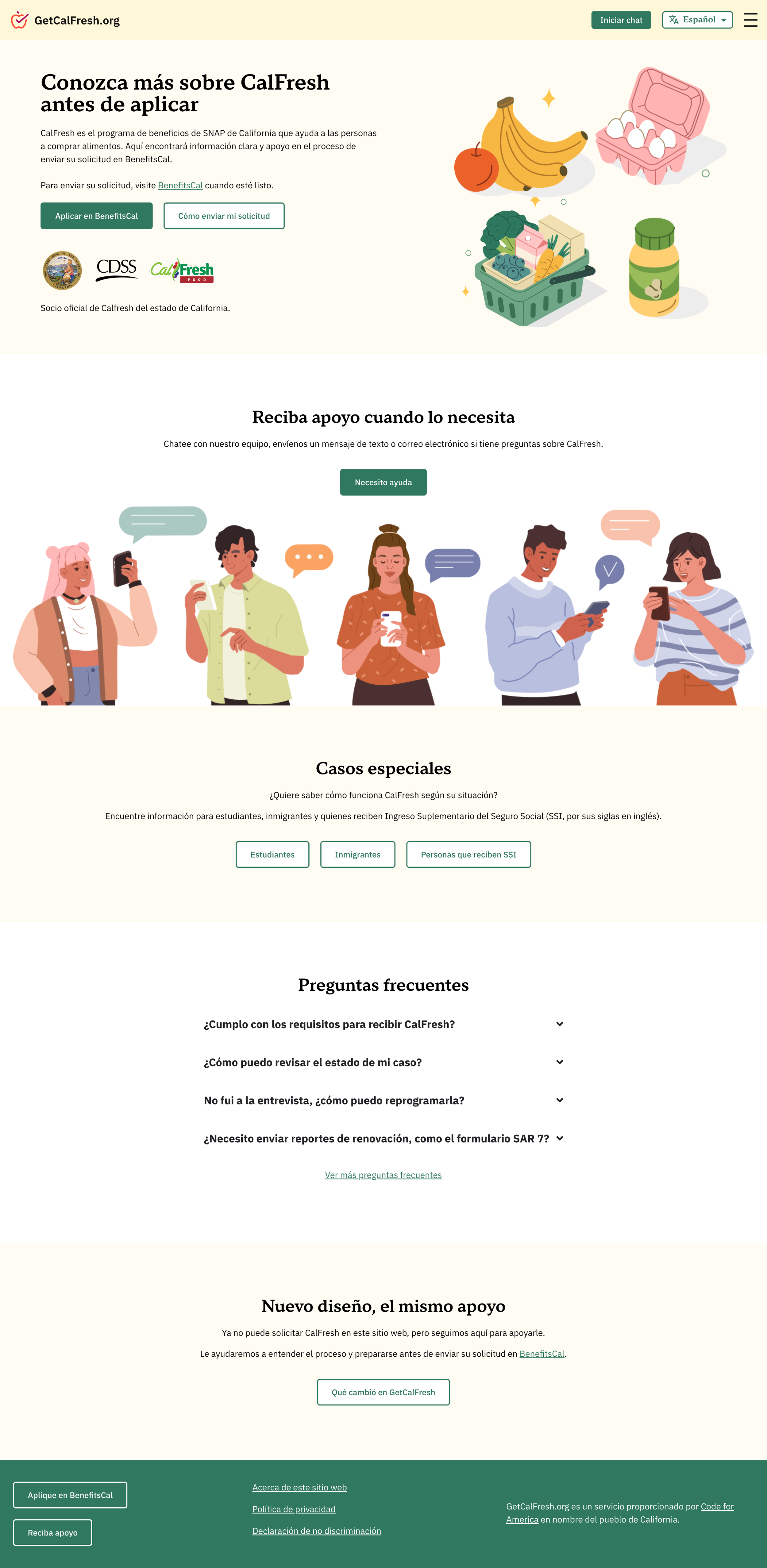
Led end-to-end qualitative research to understand barriers facing Spanish-speaking applicants using a state benefits application for SNAP (GetCalFresh). Findings revealed distinct mental models, trust dynamics, and technology constraints that were invisible in quantitative data. This led to targeted product changes, mobile infrastructure decisions, and county-level policy updates that meaningfully improved the experience for one of the program's largest underserved segments.
Quantitative data showed that Spanish-speaking residents represented the largest portion of our participation gap, or eligible people who weren't completing applications. We knew the gap existed but we didn’t know why. This research was scoped to understand the barriers embedded in the Spanish-language application experience and surface the specific needs of this community.
This research was conducted during the early months of the COVID-19 pandemic.
Previous attempts at remote research with this population revealed significant barriers: limited or no experience with Zoom, lack of access to capable devices, and low general tech familiarity. For many families, their only internet access beyond a cell phone was a school-issued Chromebook on loan for remote learning.
Given these constraints, I made the call to conduct sessions in person. They were held outside, masked, and at appropriate distance. Sessions covered participants' broader experiences with the benefits system, community perceptions and stigmas around enrollment, and a usability walkthrough of the Spanish-language application.
The methodFinding the right people to talk toRecruiting for this population required deliberate care. Spanish-speaking immigrant communities often carry real fear and distrust around government programs and the people who represent them. Standard recruiting channels like Craigslist or cold outreach to past applicants would have reinforced rather than mitigated this dynamic.
To reduce that power imbalance and reach participants through a trusted source, I partnered with a parent liaison at a local middle school with a large Latino population. The liaison made introductions and participants came in through a relationship they already trusted as opposed to a cold ask from a government-adjacent organization.
How do Spanish-speaking residents interact with and navigate the application?
What are the unmet needs, mental models, and barriers specific to this population?
How do Spanish-speaking residents make the decision to apply for benefits, and what information do they need to feel ready?
What role does trust play in how Spanish-speaking residents engage with government digital products?
Research QuestionsKey InsightsTechnology access is constrained and context-dependent.
Most participants' only non-phone internet access was through a borrowed device. Comfort using digital products was largely limited to apps and sites they navigated regularly on their own phone which meant that anything outside of that felt unfamiliar and high-stakes.
This population researches before they apply.
Participants didn't immediately begin the application. They wanted to fully understand the program before submitting anything. This meant reading carefully, talking to neighbors, and searching for answers before committing. The application needed to function as an information resource, not just a form.
Previous experiences with the system created long lasting distrust.
Many participants carried negative histories with the benefits system: confusing paperwork, unclear communication from county offices, and frustrating document submission processes. This context shaped how they approached the digital product with skepticism and caution.
Quotes attributed by research participantsImpactProduct
The research findings drove changes across the core product experience. The team hardened mobile responsiveness as a priority which for this population, wasn't a secondary use case, it was the primary one. Data storage on shared and borrowed devices was audited and removed. The Spanish-language site's FAQ and content hierarchy were restructured to lead with the questions participants were actually asking like: immigration status, effects on children, and impact on other benefits. Recognizing that trust in this community travels through relationships rather than advertising, the team utilized tooling that let partner organizations easily generate QR codes and shareable quick links, lowering the barrier for community-based organizations to spread awareness through networks people already trusted.
Policy
The research also opened doors into county-level policy conversations. Findings about confusing official communications and frustrating document submission processes gave the team concrete, participant-grounded evidence to bring to county partners. This resulted in updated notice language and more streamlined document submission workflows across several counties. It was an early signal that rigorous qualitative research with this population could influence not just what the product did, but how the broader system around it operated.
Strategy
This research reframed how the team thought about the Spanish-speaking user. The participation gap wasn't primarily a UI problem but was instead rooted in trust, prior system trauma, and a fundamentally different mental model of what "applying" means. Spanish-speaking residents weren't dropping off because the form was hard to complete; many never started because they hadn't yet reached the threshold of confidence and information they needed to feel safe doing so. This shifted design strategy from optimizing the application flow to investing in the pre-application experience that helps someone decide to apply in the first place.