GetBenefitsHelp
About the project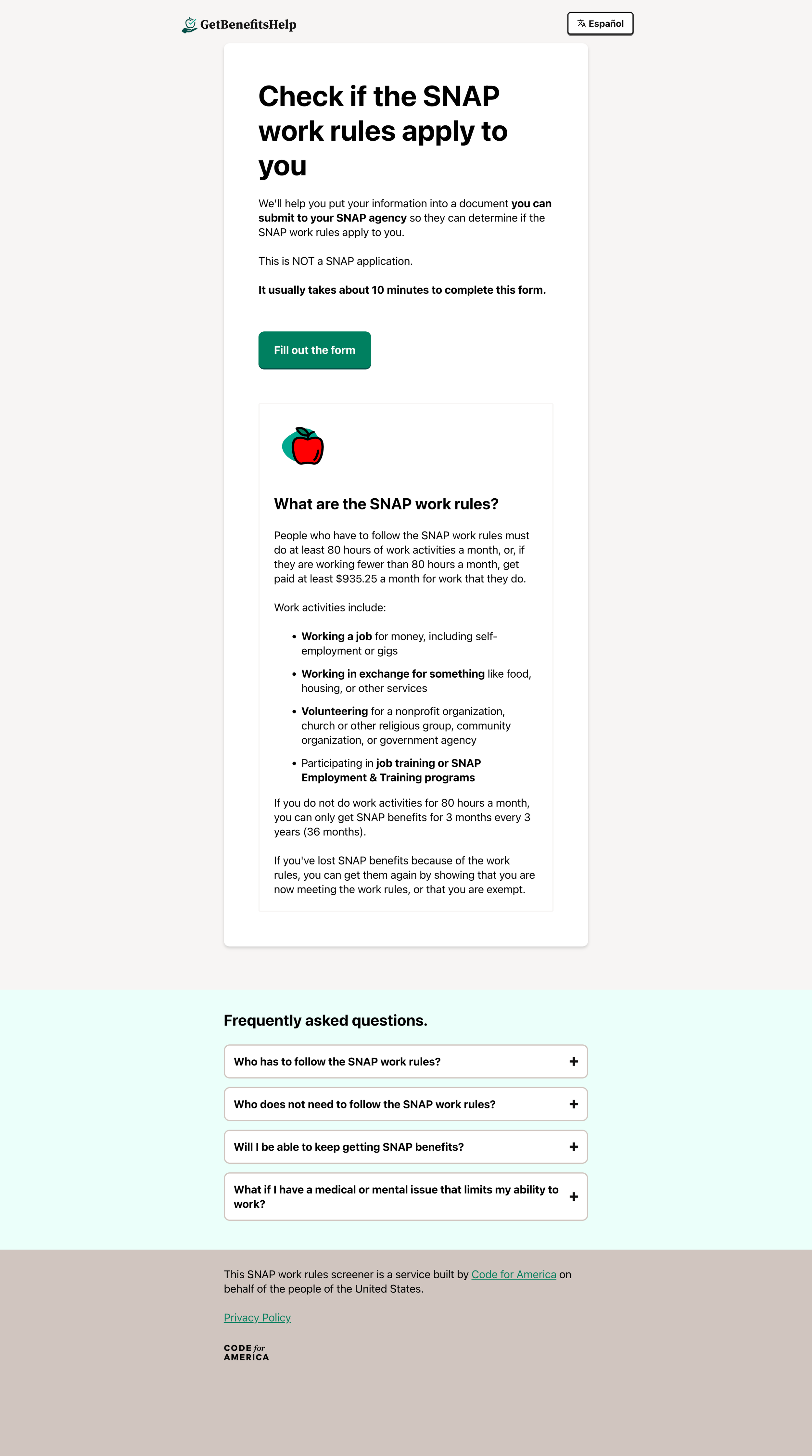
Led multi-track iterative research to transform a policy-driven SNAP work requirements tool into a human-centered digital experience. Conducted research across three user groups: (1) clients, (2) caseworkers, and (3) community-based organizations. Drove a full redesign of the product's flow, content, and supporting documentation, resulting in a tool that better serves recipients navigating a complex and consequential process.
GetBenefitsHelp (GBH) is a digital screener that helps users to navigate SNAP work requirements and create a PDF they can submit to their caseworker for proper processing. H.R. 1 introduced new SNAP work requirement rules that would affect millions of recipients across the country. GBH needed to move quickly from a policy-aligned blueprint to a fully built human-centered screener that could help people understand whether the new rules applied to them and what to do about it.
Confusion about work requirements and the lack of appropriate action can lead to people losing food assistance they are eligible to keep. The design had to be accurate, accessible, and actionable across a population with varying literacy levels, digital comfort, and language backgrounds.
Our guiding design principles shaped the work from the start: design for the human experience, build digital services that connect to the real world, and ensure the tool works for all people, across abilities, languages, and devices.
Rather than testing a single prototype with one user group, we built a layered research process across three distinct audiences, each informing a different dimension of the product.
Clients: SNAP recipients navigating work rules directly
Caseworkers: frontline eligibility workers processing and reviewing screener submissions
Community-based organizations (CBOs): partners supporting clients through the process
This three-track approach reflected a core belief: improvements to this tool would only work if they served everyone involved in this process, not just the person filling out the form.
This deliberate progression allowed each round to be built on what we learned in the previous one, giving us the ability to isolate where confusion originated whether in the questions themselves, in the resulting document, or in the translation.
The methodFinding the right people to talk toRecruiting looked different across each of the three user groups, reflecting the distinct relationships each had to the research and to the systems we were studying.
Clients were recruited through testing platforms, filtered by state and SNAP experience.
Caseworkers were significantly harder to reach -- many were reluctant to participate without explicit employer permission, and unwilling to speak with us on their own time. We found them through personal connections, county office relationships, and Reddit communities where caseworkers gathered informally.
CBOs came through programmatic outreach and relationships built through the work itself, making them partners in the research as much as participants.
How do clients understand their work rule status after completing the screener, and do they know what to do next?
Where does the "last mile" (downloading, submitting, and following up) break down?
How do caseworkers interact with the screener-generated PDF, and how does it support their workflow?
Does the Spanish-language flow accurately reflect the needs and expectations of Spanish-speaking users?
Research QuestionsKey InsightsThe screener flow itself had accumulated unnecessary complexity.
A "Share more" page that asked open-ended follow-up questions added burden without improving outcomes, so it was removed. The form preview page at the end of the flow confused users rather than created confidence, so that was removed as well. The download and email section had grown too long and was restructured into a simpler, more direct interaction.
The PDF had similar problems.
Its organization didn't match how caseworkers or clients read and used it, so the structure was reorganized to lead with the most actionable information. Legal citations that had been embedded throughout the document, a holdover from the policy-drafting process, were deprioritized in favor of plain-language summaries. Terminology was updated throughout, most notably replacing "ABAWD screener" and related policy language with "work rules," which is how clients and caseworkers actually refer to the process.
Language across the product was shifted from passive and informational to action-oriented.
Rather than telling users what the form contained, the product started directing them toward what to do with it.
Following the CBO feedback round, the team re-strategized its approach to the last mile entirely.
We conducted a dedicated research sprint on the post-screener experience and developed targeted training materials for caseworkers to support PDF adoption.
ImpactProduct
The screener flow was tightened by removing a "Share more" page that added burden without improving outcomes, and a form preview page that confused users rather than building their confidence. The download and email section was restructured into a simpler, more direct interaction. The PDF was reorganized to lead with the most actionable information, with legal citations deprioritized in favor of plain-language summaries. Language across the product shifted from passive and informational to action-oriented. This directed users toward what to do next rather than describing what the form contained. Terminology was updated throughout, most notably replacing policy language like "ABAWD screener" with "work rules," which is how clients and caseworkers actually talk about the process.
Strategy
The iterative three-track research model -- testing separately with clients, caseworkers, and CBOs -- proved essential to understanding the full picture. Problems that clients didn't name directly surfaced through CBO feedback, and caseworker confusion about the PDF would have gone undetected in client-only testing. The process also surfaced an honest organizational finding: there was only so much the team could learn without a formal state or county partner in place. That constraint directly shaped the next phase of the product's development and the team's partnership strategy going forward.